- Author: Valentina Maini
- Title: Traditional materials and building techniques: a system for a sustainability
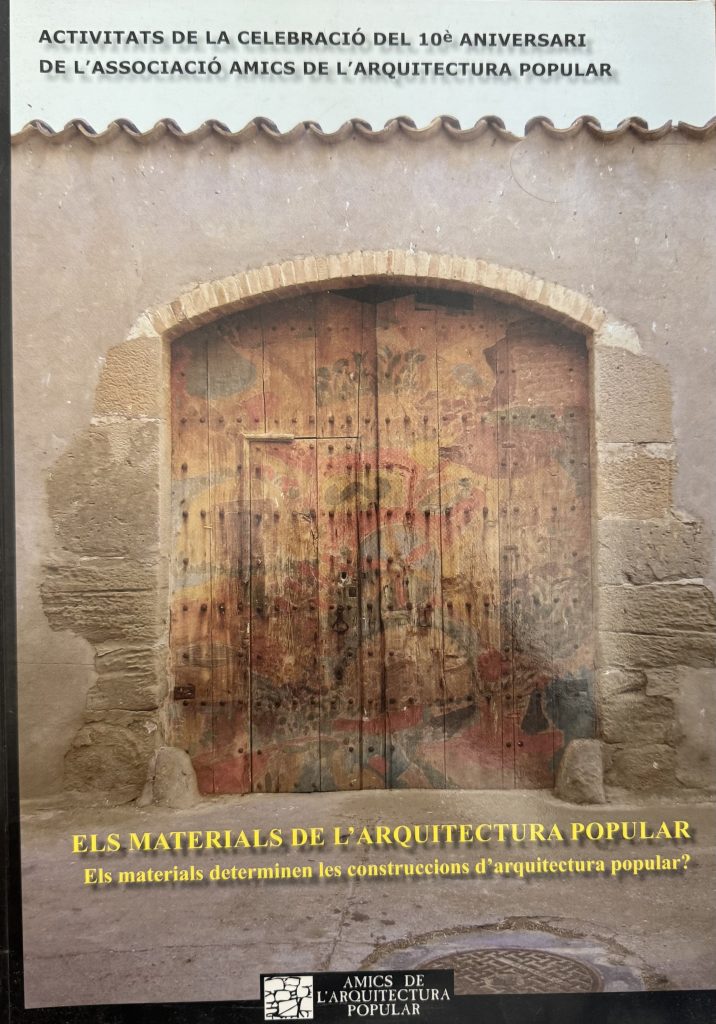
- in “”International Congress Salud y Habitat””Els Materials de l’Arquitectura Popular”
- edited by Associació amiss de l’arquitectura Popular, 2012
Materials for Sustainability: Revisiting Traditional Knowledge in Contemporary Practice
This text revisits a lecture delivered in 2009 and later published in 2012, reflecting on the role of traditional construction materials and techniques as a foundational system for sustainability. While the context of its origin predates many of today’s environmental frameworks, its arguments remain strikingly актуal and, in many respects, anticipatory of current debates.
At its core, the lecture proposes a shift in perspective: just as the Renaissance rediscovered classical knowledge to redefine cultural paradigms, the present ecological transition demands a renewed engagement with pre-industrial construction systems. These systems—based on materials such as earth, straw, wood, and stone—embody a form of environmental intelligence rooted in long-term observation, local adaptation, and the integration of material, technique, and territory.
The text highlights how the progressive loss of this “constructive memory” has led not only to a homogenization of building practices but also to significant risks in heritage conservation. Inappropriate interventions—such as the use of cement in earthen structures or the replacement of timber systems with reinforced concrete—are symptomatic of a broader disconnection between contemporary practice and traditional knowledge systems.
From an environmental standpoint, natural materials present clear advantages: low embodied energy, renewability, recyclability, and, in many cases, biodegradability. The article emphasizes that, when evaluated across their full life cycle, these materials can drastically reduce CO₂ emissions compared to industrial alternatives. However, it also introduces a critical nuance: sustainability is not inherent to the material alone but depends on the conditions of its production, transformation, and integration within ecosystems.
A key contribution of the lecture lies in its systemic reading of traditional architecture. Beyond material selection, it underscores the importance of passive design strategies—where form, orientation, and material properties are combined to achieve high levels of comfort without external energy inputs. Vernacular examples, such as wind towers or thick earthen walls, demonstrate how climatic responsiveness can be embedded in the very logic of construction.
The text also addresses the tension between tradition and innovation. Far from advocating a nostalgic return to the past, it calls for a hybrid approach in which contemporary technologies—mechanization, prefabrication, digital networks—enhance rather than replace traditional systems. The emergence of prefabricated straw panels or mechanized rammed earth techniques illustrates this potential for integration, expanding the applicability of natural materials within current regulatory and economic frameworks.
Equally relevant is the reflection on socio-economic dimensions. Traditional materials are described as inherently “social,” as their use is often tied to local resources, community participation, and accessible construction processes. Yet, paradoxically, in contemporary markets they can become more expensive due to limited industrialization and distribution. This contradiction reveals the need for institutional support, research investment, and regulatory adaptation to enable their broader adoption.
Finally, the lecture identifies the main barriers that continue to limit the use of natural materials: cultural prejudice, lack of technical knowledge, insufficient normative frameworks, and fragmentation among stakeholders. Overcoming these obstacles requires coordinated action—linking research institutions, professionals, industry, and public administrations—in order to build a shared and operational knowledge base.
More than a decade after its publication, this text can be read not only as a reflection but as a manifesto. It anticipates current discussions on circularity, low-carbon construction, and regenerative design, while insisting on a fundamental idea: sustainability is not merely a matter of performance metrics, but of re-establishing meaningful relationships between materials, environments, and societies.
In this sense, traditional construction techniques are not relics of the past, but active resources for redefining the future of architecture.