Using BIM ( Building Information Technology) to enhance selfbuilders
Hybrid Systems, Integrated Knowledge: BIM for Mixed Masonry and Straw Construction
The second case study introduces a more complex constructive scenario, where BIM is used to coordinate a hybrid system combining load-bearing masonry in Ytong blocks with straw bale infill and complementary timber elements. This mixed approach requires a higher level of precision in design, as each material system responds to different structural, thermal, and constructive logics. In this context, BIM becomes not only a representation tool but a coordination platform where heterogeneous systems are aligned within a single coherent model.
The project documentation reveals a highly structured set of plans, where the geometry of the building is rigorously defined through a modular grid system. The foundation plan already integrates this logic, identifying structural walls, load pathways, and dimensional relationships between elements with exact measurements and levels. The use of Ytong masonry is clearly embedded in this structural layer, providing a stable and continuous base onto which lighter systems are later assembled.
Sections play a central role in understanding the project. Longitudinal and transversal cuts describe not only the spatial configuration but also the constructive stratigraphy, from terrain adaptation to roof assembly. The relationship with topography is explicitly modeled, with precise level differences and terrain adjustments that define the building’s implantation. These sections allow the self-builder to read the building as a sequence of layers and heights, rather than as abstract projections.
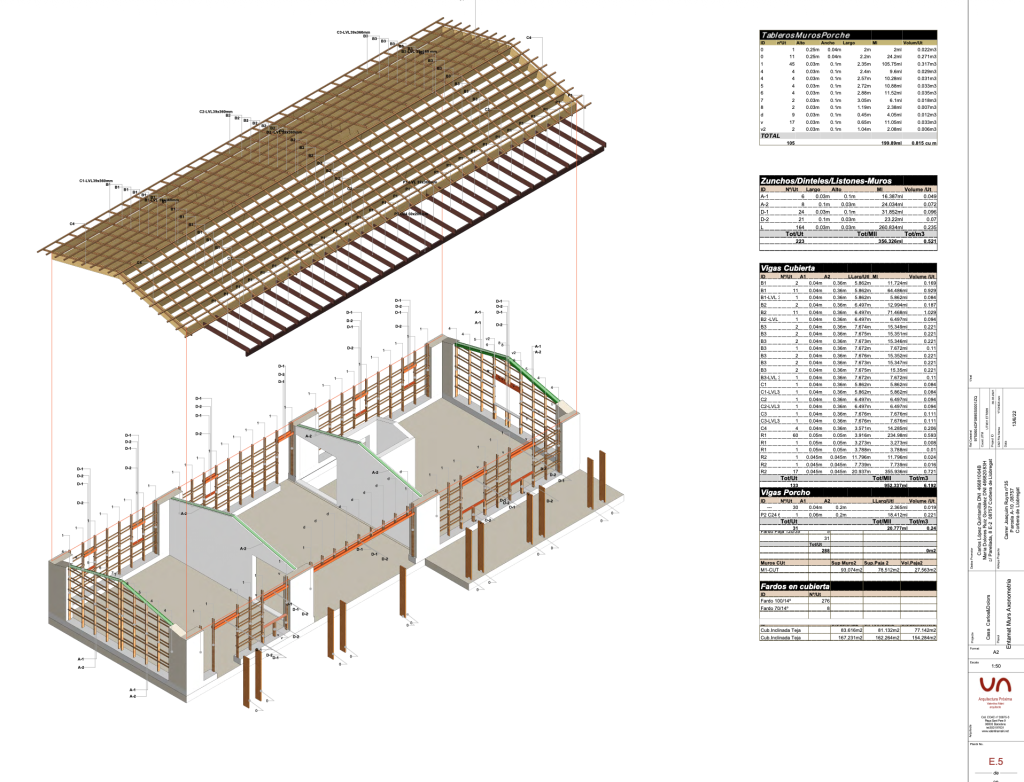
At the same time, the structural articulation between systems becomes visible in dedicated drawings. The masonry walls, identified with specific typologies, coexist with timber frameworks and lintel systems that resolve openings and load. This layered reading is essential in hybrid construction, where the logic of assembly is not uniform but negotiated between materials.
The BIM model also extends into detailed interior plans, where each space is dimensioned with millimetric precision. Kitchens, living areas, and bedrooms are not only spatially defined but constructed through a sequence of measurable components, allowing a direct translation into on-site execution. This reinforces the idea of the model as a buildable document rather than a descriptive one.
A particularly relevant aspect is the integration of performance data within the model. Envelope systems include quantified layers with associated thermal properties, such as insulation thicknesses and conductivity values. In a system combining masonry and straw, this becomes critical to ensure hygrothermal compatibility and overall energy performance.
The visualizations extracted from the BIM environment complete this system of knowledge. Exterior perspectives situate the building in its environment, showing orientation, solar exposure, and material expression. Interior views, on the other hand, translate the constructive logic into inhabitable space, making visible the continuity between structure, enclosure, and use. These images are not merely illustrative; they act as interpretative tools that allow non-expert actors to anticipate the spatial and material outcome of their work.
In this case study, BIM demonstrates its capacity to manage complexity without losing readability. By integrating masonry precision with the variability of bio-based materials such as straw, the model becomes a shared platform where design, performance, and construction converge. For self-building practices, this is particularly significant: it enables the coordination of hybrid systems while maintaining clarity, supporting a process where different techniques can coexist within a controlled and accessible framework.