Using BIM ( Building Information Technology) to enhance selfbuilders
Building Before Building: BIM as a Tool for Self-Building Practice
The integration of Building Information Modeling (BIM) into small-scale residential projects opens a particularly relevant field of experimentation when applied to self-building processes. Beyond its conventional use in professionalized construction environments, BIM can operate as a design and decision-making tool that anticipates the act of building itself, allowing the project to be constructed virtually before being executed on site.
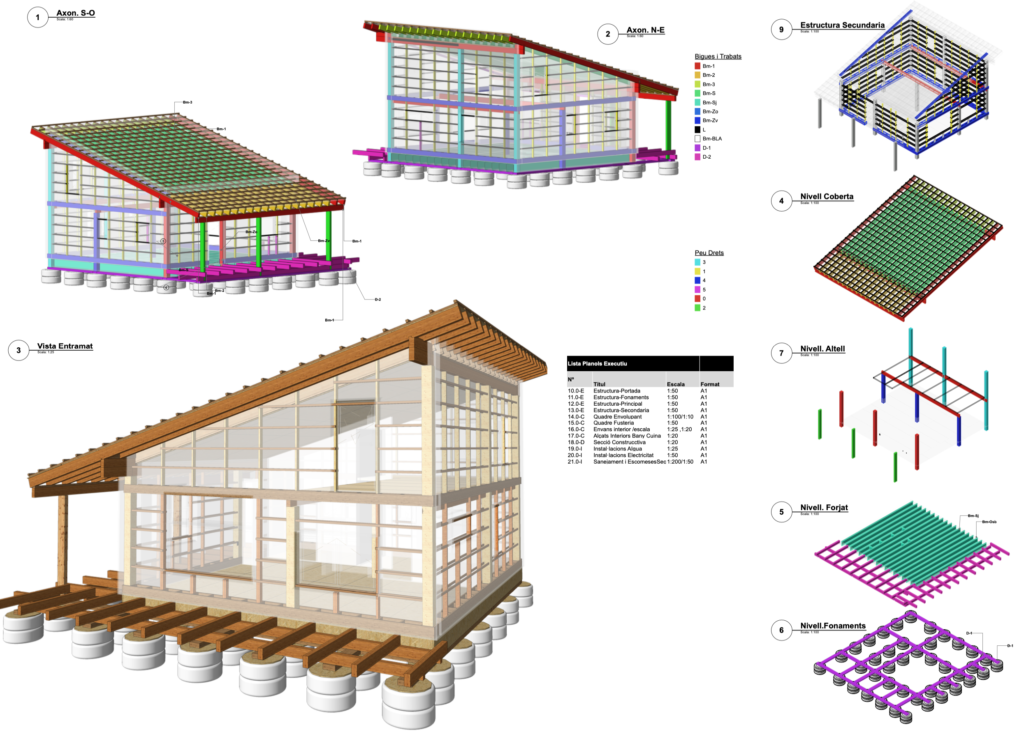
The case study developed for the “Casa Christian” project illustrates this approach with precision. The BIM model is not only a geometric representation, but a fully informed system where each element contains dimensional, material, and constructive data. Sections, plans, and axonometries extracted from the model show a level of definition that makes the constructive logic immediately legible, even for non-expert actors involved in the building process.
One of the key contributions of BIM in this context is the capacity to generate exact measurements of quantities. The model provides detailed calculations of surfaces, volumes, and thicknesses of each constructive component, from structural elements to interior partitions and envelope systems. For instance, the project includes precise quantification of façade systems, with differentiated layers such as lime, straw insulation, and clay finishes, each measured in square meters and cubic volumes.
This level of detail extends to the entire building system. The internal organization of spaces is quantified with exact surface and volume data, allowing a clear understanding of spatial proportions and material needs. The full house, with a total useful area of 76.38 m² and a volume of over 223 m³, is broken down into individual rooms, each with its own measurable parameters.
Similarly, the structural system is fully described through the model, including the number, dimensions, and volumes of beams, pillars, and panels. This enables a direct translation from digital model to construction logistics, reducing uncertainty and facilitating procurement and execution.
For self-builders, this precision has a direct operational impact. The availability of exact quantities allows better cost control, reduces material waste, and supports phased construction strategies. At the same time, the visual clarity of the 3D model and its derived drawings simplifies the understanding of complex constructive assemblies, transforming technical documentation into an accessible and readable guide.
In this sense, BIM acts as an interface between design and construction, but also between professional knowledge and user participation. It enables a shift from abstract representation to actionable information, supporting processes where the builder is also the inhabitant. Rather than replacing traditional knowledge or manual skills, it enhances them by providing a structured and transparent framework for decision-making.
The experience of this case study suggests that BIM, when adapted to small-scale and participatory contexts, can become a powerful tool to democratize access to construction knowledge. By building before building, it allows self-builders to engage with the project not as passive recipients of drawings, but as active agents in the construction process.